Samples > Manufacturing Resume Samples
- A Proven Framework for Writing a Production Planner Resume

Amos Tayts
2025
10min read



Juggling production schedules, inventory levels, and delivery deadlines is complex - but writing a resume that captures these skills can feel impossible. Your daily impact on manufacturing efficiency deserves more than a basic bullet list.
Are you struggling to showcase your planning expertise and quantifiable results? A strategically crafted resume can transform your complex coordination skills into compelling achievements that catch a hiring manager's attention.
At Resume Target, we understand how to translate production planning expertise into powerful success stories. Our guide will show you exactly how to highlight your ability to optimize workflows, reduce costs, and deliver results that make employers take notice.

At the heart of every successful manufacturing operation, Production Planners orchestrate the complex dance of materials, machinery, and workforce to ensure seamless product lifecycle management from initial acquisition through final delivery.
Your role as a Production Planner involves analyzing production schedules, coordinating with multiple departments, and maintaining optimal inventory levels while juggling real-time adjustments to meet changing customer demands and production targets.
Whether you're just starting out or looking to advance your career, the production planning field offers diverse opportunities for growth, from specializing in specific industries to advancing into senior planning roles or supply chain management positions.
Let's talk about what's exciting in the Production Planner career path! Your earning potential as a Production Planner can be quite impressive, with opportunities to significantly increase your income as you gain experience and expertise. And guess what? Location and specialization can really boost your earning power, with some states offering exceptionally competitive compensation packages.
Figures from: Talent.com
Production Planners can advance from entry-level positions to senior management roles by mastering supply chain operations and developing leadership abilities. Your career growth depends on building expertise in logistics, inventory management, and team coordination.
To accelerate your career growth, you'll need to master both technical skills like SAP Applications and Material Requirements Planning (MRP), alongside essential soft skills such as leadership and strategic thinking.
Technical Skills: - Supply Chain Management - Inventory Control Systems - SAP Applications - Material Requirements Planning - Data Analysis Soft Skills: - Strategic Planning - Team Leadership - Problem-Solving - Communication - Project ManagementLaunch your production planning career by combining entry-level supply chain experience with strong analytical skills, as many employers are actively seeking fresh talent to develop into full-fledged Production Planners.
To build your foundation for success, you'll need to develop expertise in inventory management and supply chain operations, which you can gain through starter positions like Production Coordinator, Inventory Clerk, or Supply Chain Assistant.
• Production Coordinator Assistant • Junior Inventory Analyst • Supply Chain Trainee • Materials Planning Clerk • Production Scheduling AssistantRequirements from ASCM
From government agencies to private enterprises, Production Planners are in high demand across both coasts and major metros.
Figures from U.S. Bureau of Labor Statistics
Here's what's exciting: You'll find opportunities in both traditional manufacturing hubs and emerging business centers. And guess what? With federal agencies leading the hiring charge, you can explore careers with excellent stability and benefits.
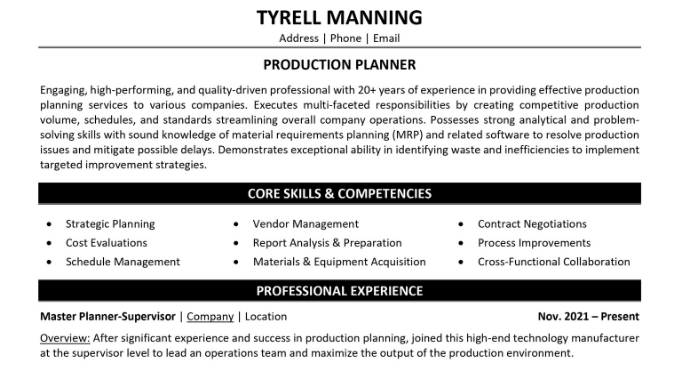
Struggling to showcase your production scheduling expertise, inventory management skills, and supply chain accomplishments in a way that catches a hiring manager's eye? This comprehensive, section-by-section guide will walk you through creating a production planner resume that highlights your most impressive achievements and core competencies.
As a Production Planner, you know how to optimize complex workflows and schedules, but condensing your professional value into a few powerful sentences can feel like fitting a month's production schedule onto a sticky note.
While you excel at analyzing data, managing inventory levels, and coordinating with multiple departments, translating these technical skills into compelling resume language that catches a hiring manager's attention requires a different kind of strategic planning.
How would you characterize your approach to balancing production efficiency with resource optimization across your career in planning roles?
Reason: This question helps you articulate your overall philosophy and high-level impact as a Production Planner, setting the tone for your professional brand and demonstrating strategic thinking.
What would you say are the most valuable production planning systems and methodologies you've mastered that have shaped your professional expertise?
Reason: This helps frame your technical foundation and methodology expertise without listing specific tools, allowing you to position yourself as a well-rounded planning professional.
How would you describe your role in bridging communication between manufacturing operations, supply chain, and other stakeholders throughout your career?
Reason: This question helps you articulate your cross-functional leadership abilities and communication skills, which are crucial differentiators for senior Production Planners.
As a Production Planner, your role requires a unique blend of analytical expertise, technical proficiency, and interpersonal abilities that need to be strategically presented on your resume.
From mastering MRP systems and inventory management software to coordinating with multiple departments and managing production schedules, you'll need to showcase both your high-level planning capabilities and day-to-day operational skills that keep manufacturing processes running smoothly.
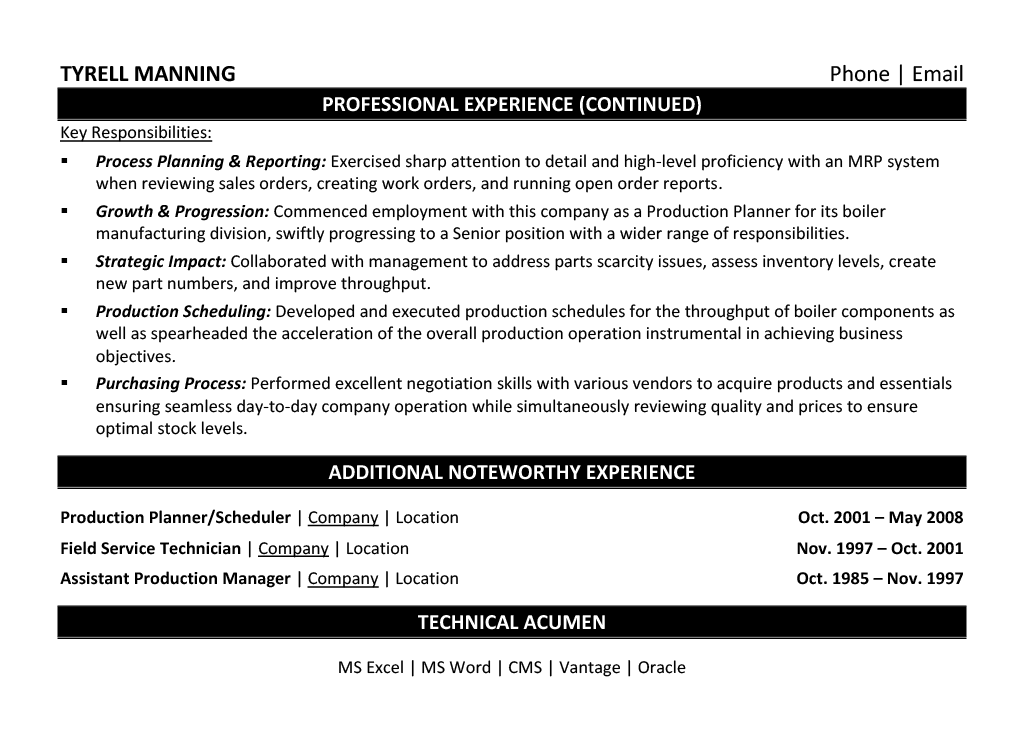
Showcase your production planning expertise by organizing your experience into three powerful sections: a concise role overview that sets the stage, measurable achievements that highlight your impact on efficiency and output, and core responsibilities that demonstrate your mastery of production workflows.
Many Production Planners struggle to effectively demonstrate how their behind-the-scenes coordination work directly impacts bottom-line business results. Transform your planning expertise into compelling achievements by connecting your process improvements and inventory management decisions to measurable cost savings, efficiency gains, and enhanced production throughput.
The responsibilities section demonstrates how Production Planners optimize manufacturing workflows and coordinate resources across departments. Your role directly impacts operational efficiency and bottom-line results, so frame your duties in ways that showcase both technical expertise and business value.
Your education and certifications demonstrate your expertise in production planning and supply chain management. Focus on highlighting relevant credentials that showcase your knowledge of MRP systems, lean manufacturing principles, and production control methodologies.
Now that you've built a strong foundation using Resume Target's proven resume writing guidelines, you're ready to transform your resume into a powerful tool for landing production planning positions.
While many job seekers only customize their cover letters, tailoring your resume for specific Production Planner roles is crucial for standing out in today's competitive manufacturing job market.
A carefully customized resume not only helps you bypass ATS systems by incorporating role-specific keywords, but it also demonstrates to hiring managers that your production planning experience and skills align perfectly with their unique operational needs.
Ready to turn your resume into your secret weapon? Let's make every word count and show employers you're the production planning expert they've been searching for!
Don't let a lack of experience hold you back from launching your career as a Production Planner!
Your journey into production planning can start strong by showcasing your relevant coursework, analytical skills, and any supply chain or operations management projects you've completed during your education.
Focus on highlighting your organizational abilities, technical proficiency with planning software, and understanding of manufacturing processes.
For more detailed guidance on crafting your resume, check out the Student Resume Writing Guide to ensure you're including all the essential elements.
Your resume summary is your chance to showcase how your academic foundation, internships, and project experience have prepared you for a production planning role.
Focus on highlighting your analytical skills, knowledge of production processes, and any experience with planning software or supply chain concepts to create a compelling narrative.
"Detail-oriented and methodical Production Planner with hands-on experience through academic projects and internship exposure to manufacturing environments. Proficient in MS Excel, ERP systems, and inventory management principles, with demonstrated success in reducing waste by 15% during university capstone project. Strong analytical and problem-solving abilities combined with excellent communication skills developed through collaborative team projects. Seeking to leverage manufacturing operations knowledge and planning expertise to optimize production efficiency and contribute to operational excellence."
Now's your chance to showcase the educational foundation that prepared you for success in production planning and manufacturing operations!
Don't just list your degree - highlight relevant coursework like "Supply Chain Management"or "Operations Planning,"and feature impactful projects where you created production schedules, analyzed workflows, or optimized inventory systems.
The courses common to a degree/certification for Production Planners are Beginning Microsoft Excel, Intermediate Microsoft Excel, Inventory Management, Lean Concepts, and Technology in the Supply Chain.Relevant Coursework: Beginning Microsoft Excel | Intermediate Microsoft Excel | Inventory Management | Lean Concepts | Technology in the Supply Chain | Supply Chain Analytics
Key Projects:
Manufacturing Optimization Simulation: Developed comprehensive production scheduling model using Excel and simulation software to optimize workflow and reduce bottlenecks in a mock manufacturing facility.
Supply Chain Integration Project: Collaborated with cross-functional team to develop an integrated production and inventory management system for a local manufacturer case study.
Leverage your educational background, internship experiences, and technical training to showcase the precise mix of planning, analytical, and software skills that manufacturing employers seek in entry-level production planners.
As an aspiring Production Planner, highlighting these foundational skills will demonstrate your readiness to step into this dynamic role, where opportunities for advancement grow alongside manufacturing industry expansion.
Let's face it - translating your complex production scheduling expertise and inventory management skills into clear, compelling achievements can feel like optimizing an impossible workflow.
At Resume Target, we specialize in crafting resumes for manufacturing professionals just like you, having helped countless production planners showcase their impact in areas like lean manufacturing implementation and supply chain optimization.
Our deep understanding of the manufacturing sector means we know exactly how to position your skills to stand out, whether you're coordinating with multiple departments or managing critical KPIs.
With manufacturing companies actively seeking skilled production planners who can drive efficiency, now is the perfect time to transform your resume into a powerful career tool - let's connect today to get started.