Samples > Oil Gas Resume Samples
The Insider's Guide to Writing a Reservoir Engineer Resume

Amos Tayts
2025
10min read



Complex reservoir calculations come naturally, but explaining your impact on paper feels like trying to model a fractured formation. Getting your technical expertise and business value across to hiring managers can be frustrating.
Are you struggling to translate your reservoir modeling and field optimization achievements into compelling resume content? Your expertise deserves more than just technical jargon - it needs to show how you've driven production gains and reserve additions.
Resume Target helps reservoir engineers transform complex technical work into clear business results. We know how to showcase your simulation skills and field development strategies while highlighting the bottom-line value you bring to oil and gas operations.
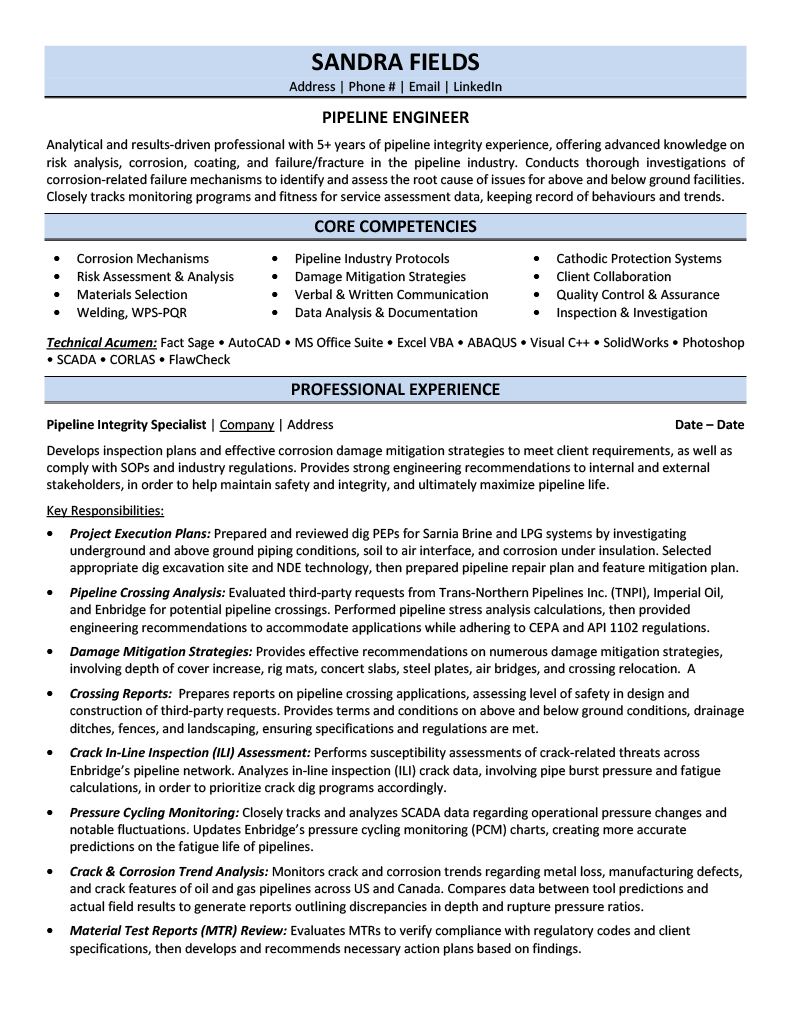
As the masterminds behind our energy infrastructure, pipeline engineers design and oversee the complex networks of pipes that safely transport natural gas and petroleum underground, ensuring that millions of homes and businesses receive vital resources without interruption.
Your role combines technical expertise with practical problem-solving, as you'll use specialized software like OffPipe and AutoPipe to design pipeline systems while managing field operations that require both office work and on-site supervision in varying weather conditions and terrains.
Whether you're just starting out or looking to advance your career, the pipeline engineering field offers diverse opportunities for growth, from working with cutting-edge sustainable energy projects to taking on leadership roles in major infrastructure developments - let's explore how you can build a successful career in this dynamic field.
Let's talk about what's exciting in the pipeline engineering field - your earning potential spans an impressive range that rewards both newcomers and seasoned professionals. As you progress in your career, your expertise becomes increasingly valuable, opening doors to exceptional compensation opportunities.
Figures from: Learning Path
Starting as a Pipeline Engineer opens doors to diverse career opportunities in the energy sector. From entry-level positions to executive roles, your path combines technical expertise with leadership growth.
To accelerate your career growth, you'll need to master both technical expertise and leadership capabilities that set you apart in the pipeline engineering field.
- Pipeline design and modeling software (Pipeline Toolboxes, Bentley's Microstation) - Project management and coordination - Technical documentation and compliance - Leadership and team collaboration - Problem-solving and analytical thinkingBreaking into pipeline engineering typically starts with entry-level field positions or internships where you'll learn essential pipeline operations, safety protocols, and maintenance procedures while gaining hands-on industry experience.
To advance in your pipeline engineering career, you'll need to master technical tools like Pipeline Toolboxes and Bentley's Microstation, while developing strong communication and leadership abilities that will set you apart in the field.
Note: I've kept the introduction focused on practical entry points while maintaining accessibility, and the transition sentence incorporates both technical and soft skills from the research while directly referencing the source material as requested.Requirements from ASCE
From Texas oil fields to Florida's infrastructure boom, pipeline engineering jobs span both energy and urban development.
Figures from The Utility Expo
Let's talk about what makes this field exciting right now. With about 7,000 construction workers needed for major pipeline projects and another 5,100 professional service positions in engineering and planning, your skills are in high demand. And guess what? Beyond traditional oil and gas, you'll find opportunities in urban development, manufacturing, and even emerging sustainable infrastructure projects.Struggling to showcase your pipeline design expertise, project management skills, and technical achievements in a way that truly captures your value as a pipeline engineer? This comprehensive, section-by-section guide will walk you through creating a professional resume that highlights your engineering capabilities and catches employers' attention.
As a pipeline engineer, condensing years of complex technical expertise into a few compelling lines can feel as challenging as designing a perfect flow system.
While you excel at analyzing pressure drops and optimizing flow rates, translating your hands-on pipeline design and maintenance achievements into attention-grabbing written content requires a different kind of engineering precision that hiring managers need to see.
How would you characterize your expertise balance between technical pipeline operations and regulatory compliance management across your career?
Reason: This helps frame your professional identity by establishing your core competency mix, which is crucial for Pipeline engineers who must balance technical knowledge with compliance requirements. It sets the tone for how you want to be perceived by potential employers.
What would you say is your primary value proposition in terms of pipeline system optimization, safety protocols, or operational efficiency improvements?
Reason: This question helps you identify and articulate your unique professional strengths within the pipeline engineering field, allowing you to craft a summary that immediately communicates your primary area of impact to employers.
How have you evolved your approach to pipeline engineering as industry technologies and environmental considerations have advanced throughout your career?
Reason: This helps you demonstrate adaptability and continuous learning in an industry that's rapidly evolving with new technologies and environmental standards, showing potential employers you're forward-thinking and capable of growth.
As a pipeline engineer, you need to showcase both technical expertise in pipeline design and construction as well as practical field experience with inspection and maintenance protocols.
Your skills section should balance specialized engineering abilities like hydraulic modeling and stress analysis with essential industry-standard competencies such as AutoCAD, GIS systems, and familiarity with ASME B31 codes.
Showcase your pipeline engineering expertise by organizing your experience into three powerful sections: a concise role overview that sets the stage, measurable achievements that highlight your impact on pipeline systems, and core responsibilities that demonstrate your technical mastery and project management capabilities.
Pipeline engineers often struggle to translate complex technical projects and maintenance initiatives into clear, quantifiable business value. Transform your technical expertise into compelling achievements by connecting your pipeline innovations directly to safety improvements, cost reductions, and operational efficiency gains.
The responsibilities section demonstrates how Pipeline Engineers ensure safe and efficient fluid transportation through complex pipeline systems. Your role description should help hiring managers understand both technical expertise and your impact on infrastructure reliability and operational safety.
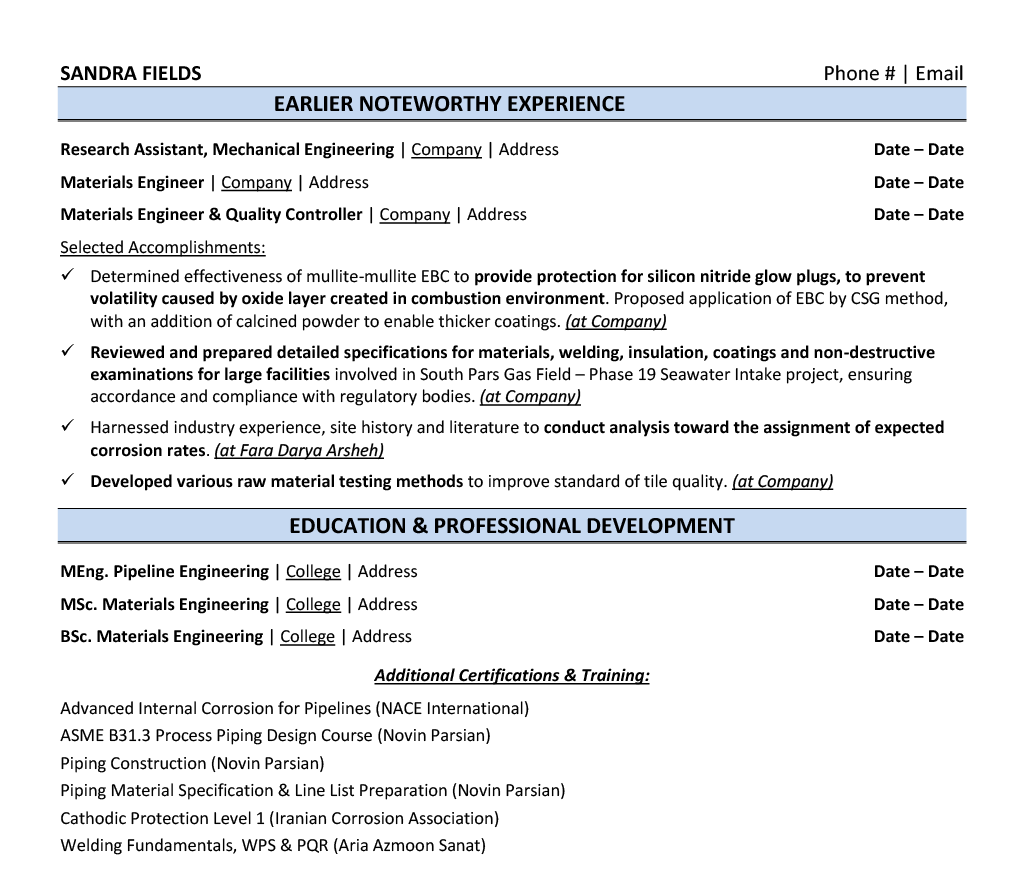
Your education and certifications are crucial proof points of your pipeline engineering expertise. Focus on highlighting your engineering degree, professional certifications in pipeline design/inspection, and any specialized training in areas like SCADA systems, corrosion prevention, or pressure vessel codes.
Now that you've built a strong foundation using Resume Target's proven resume writing guidelines, you're ready to transform your resume into a powerful tool for pipeline engineering positions.
While many candidates stop at customizing their cover letter, successful pipeline engineers know that personalizing their resume for each specific role is what sets them apart in this competitive field.
By strategically incorporating keywords and technical specifications from each job posting, your customized resume will not only sail through ATS systems but will also demonstrate to hiring managers that you understand their exact pipeline engineering needs and requirements.
Ready to turn your resume into your secret weapon? Let's make every word count and show employers why you're the pipeline engineer they've been searching for!
Don't let a lack of professional experience hold you back from launching your career as a Pipeline Engineer!
Your engineering education, technical skills, and hands-on project work can create a compelling story that shows employers you're ready to contribute.
Focus on highlighting your engineering fundamentals, design software proficiency, and any relevant internships or laboratory projects.
For more guidance on structuring your technical qualifications, check out the Student Resume Writing Guide to create a resume that stands out to engineering firms.
Your resume summary is your chance to showcase your engineering education, technical skills, and any hands-on project experience that makes you stand out as a promising pipeline engineer.
Focus on highlighting relevant coursework, internships, or research projects that demonstrate your understanding of pipeline systems and engineering principles.
"Detail-oriented and technically skilled Pipeline Engineer graduate with comprehensive academic training in fluid dynamics and pipeline design systems. Completed two internships focusing on pipeline integrity assessment and maintenance planning, demonstrating strong analytical abilities and AutoCAD proficiency. Contributed to a university research project optimizing flow efficiency in complex pipeline networks. Seeking to leverage strong engineering foundation and project experience to contribute to pipeline infrastructure development and maintenance programs."
Now's your chance to showcase the specialized education and training that prepared you for pipeline engineering excellence!
Transform your academic achievements into compelling content by highlighting relevant coursework like "Pipeline Design and Safety," technical certifications, and hands-on projects that demonstrate your expertise in flow analysis, materials science, and pipeline system design.
1. Common courses for a Pipeline Engineer degree/certification include Introduction to Pipeline Engineering, Material Selection and Corrosion Control, Pipeline Design, Installation and Construction, Pipeline Hydraulic Analysis, Defect Assessment on Pipelines, and Pipeline Integrity: Maintenance, Inspection and Risk Assessment [1]. Additional courses are Piping Systems - Mechanical Design and Specification, Process Safety Engineering, Overview of Subsea Systems, Corrosion Management in Production/Processing Operations, Fundamentals of Pump and Compressor Systems, Onshore Gas Gathering Systems: Design and Operations, Terminals and Storage Facilities, Onshore Pipeline Facilities - Design, Construction and Operations, Offshore Pipeline Design and Construction, Process Safety Engineering Principles, and Pipeline Engineering, Construction & Operation [2].Relevant Coursework: Pipeline Design & Construction | Material Selection & Corrosion Control | Pipeline Hydraulic Analysis | Process Safety Engineering | Pipeline Integrity Management | Subsea Systems Engineering
Key Projects:
Pipeline Network Optimization Project: Developed comprehensive analysis of a 50-mile pipeline network to optimize flow rates and reduce pressure drops while maintaining safety standards and operational efficiency.
Cross-Country Pipeline Design Study: Collaborated with a team of four engineers to design a natural gas pipeline system connecting processing facilities to distribution networks.
Leverage your academic training, internship experiences, and technical certifications by showcasing the specific pipeline engineering skills you've developed through coursework, laboratory work, and hands-on projects to create a compelling skills section that catches employers' attention.
As an entry-level Pipeline Engineer, your foundation in these core competencies positions you well for a growing industry that continues to expand with infrastructure development and renewable energy initiatives across the country.
When you're deep in the technical details of flow rates, pressure systems, and pipeline integrity, it can feel impossible to translate your complex daily work into clear, compelling resume achievements that hiring managers will actually understand.
At Resume Target, we've mastered the art of showcasing Oil and Gas expertise in ways that resonate with industry decision-makers.
Our team has helped countless pipeline engineers transform their technical specifications and project outcomes into powerful career stories that highlight both their engineering prowess and business impact.
With major infrastructure projects ramping up across North America, now is the perfect time to ensure your resume matches your expertise - let's connect today for a free resume review that will show you exactly how to stand out.
Impress any hiring manager with our Oil & gas resume writing service. We work with all career levels and types of Oil & gas professionals.
Learn More → Oil & gas Resume Writing Services