Actuary
Resume Sample
A real resume example showing how we transform 30+ years of actuarial and data analytics experience into interview-winning proof.
Being qualified isn't enough — you need to be the obvious choice.
We fix your resume with one conversation
What Makes a Strong Actuary Resume?
You're Not Unqualified.
You're Overlooked.
Marco had 30 years of experience, an FRM, CFA, and CPA — and his resume was getting filtered out. Not by ATS software. By hiring managers who couldn't see what made him different from the other 49 applicants. His resume listed what he did. It didn't prove what changed because he did it.
Here's what his resume said before our interview — and what it said after:
The solution was recognized by leadership as a best-in-class approach and subsequently adopted by 3 additional divisions."
Presented findings to senior leadership, securing approval for $2.5M in follow-up investments."
Two mentees were subsequently promoted within 18 months of completing the program."
The Problem Isn't Your Career. It's That Nobody Has Asked You the Right Questions.
Most people sit down to write their resume and freeze. They stare at a blank screen thinking "I don't have any real accomplishments" or "I just did my job." That's not true — but you can't see your own career clearly from the inside. You're too close to it. The things that are genuinely impressive about your work feel routine to you because you've been doing them for years.
What Does an Actuary Resume Interview Look Like?
An actuary resume interview is a conversation where our writer asks targeted questions about your projects, probes for specific details, and extracts achievements you'd never think to include.
Developed 10 financial models supporting $12M in decisions using Bloomberg, resulting in 28% improvement in financial insights across all divisions.
The solution was recognized by leadership as a best-in-class approach and subsequently adopted by 3 additional divisions.
Every bullet on this resume was created through this same process.
Schedule Your InterviewHave questions? 1-877-777-6805
What an Actuary Resume Example That Gets Interviews Looks Like
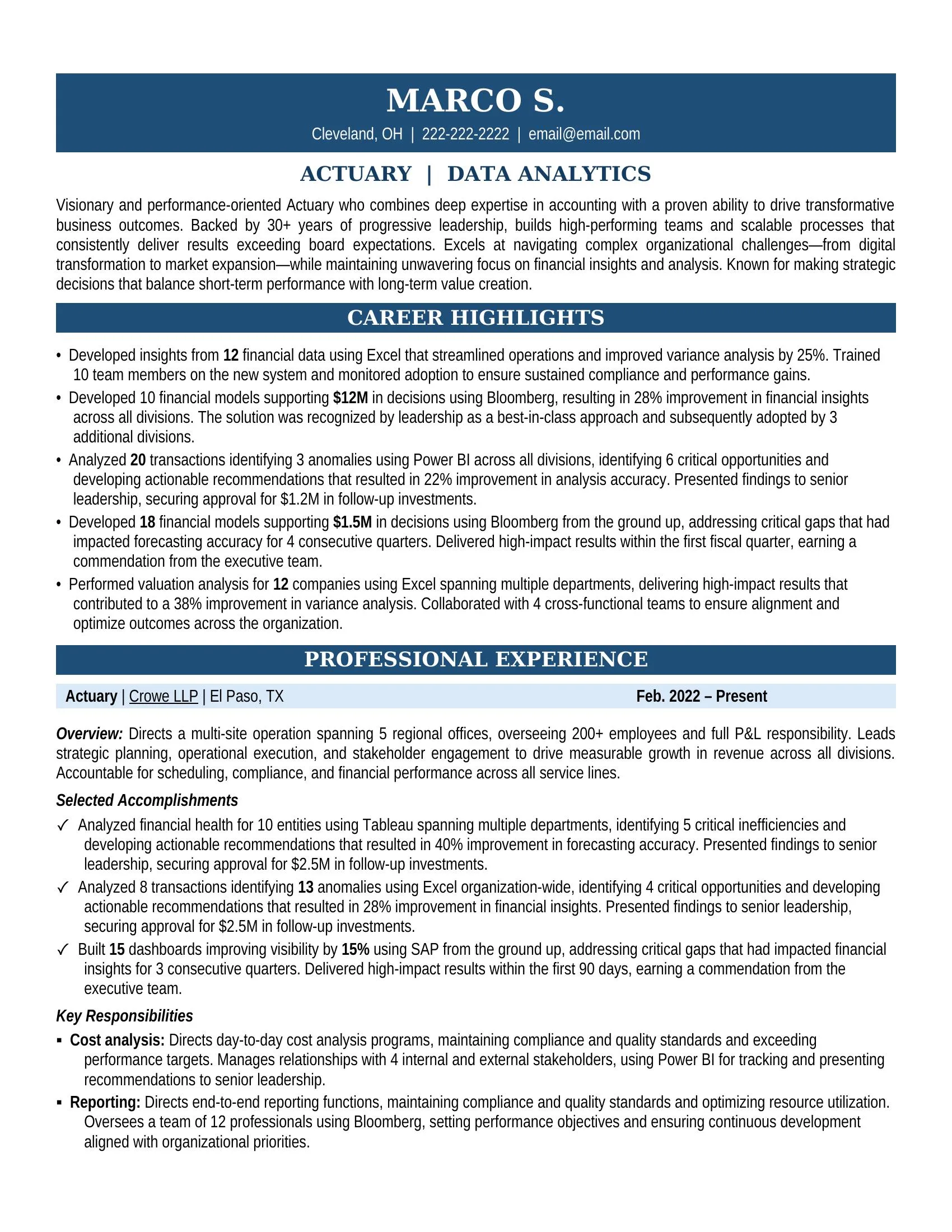
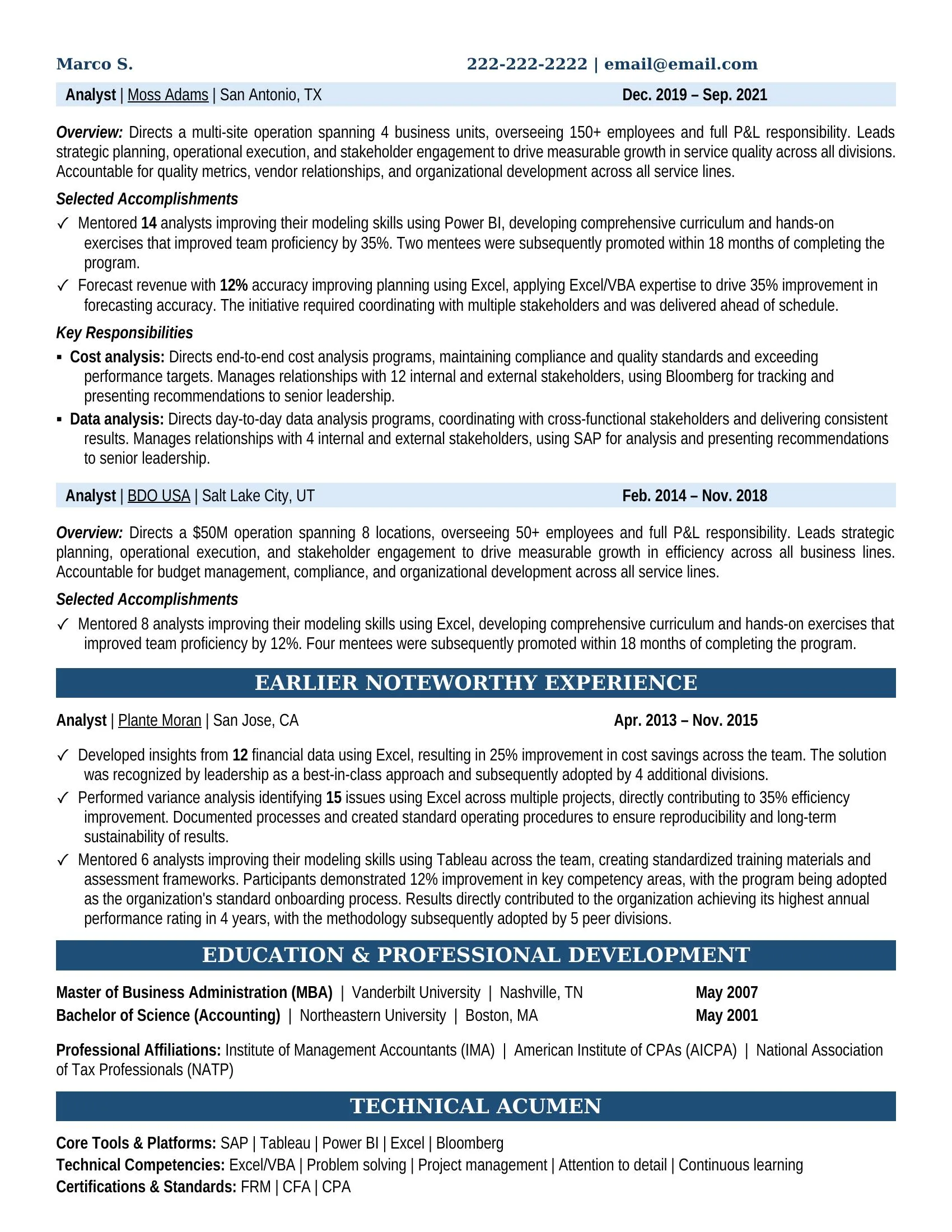
A complete actuary resume is typically 2 pages and includes a professional summary, core competencies, detailed work experience with quantified achievements, education, and certifications. Here's both pages of an actual resume created through our interview process.
Which Actuary Resume Example
Do You Need?
The actuary resume you need depends on your career stage:
Moving INTO an Actuary Role
Your resume needs to prove you can translate data into financial decisions — show modeling work, forecasting accuracy improvements, and any actuarial exam progress.
Questions We Ask in Your Interview:
- What financial models have you built, and what decisions did they support?
- Have you passed any actuarial exams or earned related certifications (CFA, FRM)?
- When have you identified a risk or anomaly that others missed?
- What is the largest dollar value your analysis has directly influenced?
What We Highlight on Your Resume:
- Financial modeling
- Statistical analysis
- Risk assessment
- Forecasting accuracy
Advancing as an Actuary
Your resume needs to demonstrate multi-site leadership, P&L responsibility, team development, and the dollar value of decisions your models have driven.
Questions We Ask in Your Interview:
- How many offices, divisions, or entities do your models serve?
- What is the total dollar value of decisions supported by your analysis?
- How many analysts have you mentored, and where are they now?
- What process or system did you build from scratch that the organization adopted?
What We Highlight on Your Resume:
- Executive leadership scope
- Revenue and investment impact
- Team development results
- Cross-divisional influence
How Do You Write an Actuary Resume That Gets Interviews?
Most actuary resumes read like a list of exams passed and tools used. Hiring managers at insurance firms and consulting companies see hundreds of them — and they all blur together. The resumes that get interviews are the ones that prove you can solve the specific problems that company is facing right now.
Marco came to us with 30+ years of experience, an FRM, CFA, and CPA — and a resume that buried all of it under generic bullet points. Our writer started by pulling job postings from companies Marco was targeting. The postings asked for someone who could unify fragmented reporting across divisions, build forecasting models that leadership would actually trust, and develop junior talent. Marco had done all of it — he just hadn't written it that way.
Through a 90-minute interview, our writer extracted the stories behind the credentials: the $12M in financial decisions his models supported, the forecasting framework three divisions adopted, the analyst he mentored into a senior role. None of that was on his original resume. Below, we break down exactly how we built each section — and the interview questions that uncovered the proof.
What Should an Actuary Put in Their Professional Summary?
Your opening line should tell a hiring manager your scope, specialization, and level — not that you're "results-driven."
Most actuary summaries open with "results-driven professional with X years of experience" — and so does every other applicant. Marco's summary works because our writer opened with the scope of his responsibility (5 regional offices, 200+ employees, full P&L) and his specialization (data analytics + actuarial modeling) before naming credentials. A hiring manager reads the first line and immediately knows: this person operates at the level we need.
If you're coming from an analyst role, most of your actuarial value is hidden inside non-actuarial job titles. Our writer finds it.
Expert Questions We Ask:
- "What's the biggest financial decision your analysis has directly influenced — even if you weren't the decision-maker?"
- "Which actuarial exams have you passed, and how far along the path are you?"
- "Have you ever caught a risk or error that someone more senior missed?"
- "What's the most complex model you've built — what made it complex?"
At the senior level, every candidate has credentials. Our writer finds the proof that makes yours stand out from another FSA or CFA.
Expert Questions We Ask:
- "How many entities, offices, or divisions rely on your work?"
- "What's the total dollar value of decisions your models have supported?"
- "What have you built that the organization adopted as a standard — something that outlasted your involvement?"
- "If I called your CFO right now, what would they say you're known for?"
What Skills Should an Actuary Resume Include?
A skills section that just lists tools is a missed opportunity. Organize by category so it signals both technical depth and leadership capability.
Listing "Bloomberg, Excel, Power BI" tells a hiring manager you have the tools. It doesn't tell them what you've done with them. Marco's resume separates tools (SAP, Tableau, Bloomberg) from competencies (variance analysis, forecasting, risk modeling) from certifications (FRM, CFA, CPA) — so ATS systems pick up the keywords and hiring managers see the strategic capability behind them.
You likely already use actuarial tools in a different context. Our writer maps your existing toolkit to actuarial job requirements.
Expert Questions We Ask:
- "Walk me through a typical analysis you do — what tools do you open and in what order?"
- "Have you ever had to explain a complex finding to someone non-technical? How did you approach it?"
- "What certifications are you pursuing, and why those specifically?"
- "What's the one tool or technique you rely on that your peers don't use?"
At the senior level, technical skills are assumed. Our writer surfaces the leadership and strategic capabilities that set you apart.
Expert Questions We Ask:
- "Have you been involved in M&A due diligence, and what was your role in the analysis?"
- "What enterprise-level system or platform have you championed or implemented?"
- "What's the largest team and budget you've run simultaneously?"
- "When has your technical judgment overridden a decision that was already in motion?"
How Do You Write Actuary Work Experience?
Every bullet should answer: what was the problem, what did you do, and what happened as a result.
The difference between a forgettable bullet and one that gets interviews is the story behind it. "Developed financial models" is a duty. "Developed 10 financial models supporting $12M in decisions, resulting in 28% improvement — adopted by 3 additional divisions" is proof of value. Our writer gets from one to the other by asking what was broken, what you built, and what changed because of it.
You've been doing actuarial-level work — you just haven't called it that. Our writer reframes your experience in actuarial terms.
Expert Questions We Ask:
- "Tell me about a time your analysis changed someone's mind about a decision they were about to make."
- "What's a problem you found that nobody asked you to look for?"
- "Have you built anything — a model, a process, a report — that your team still uses today?"
- "What's the biggest dollar amount your work has directly touched?"
- "When did you step into something above your role because nobody else could handle it?"
Senior actuaries often undersell their impact because the work feels routine to them. Our writer finds the numbers you stopped tracking.
Expert Questions We Ask:
- "What's a situation you inherited that was failing — and what did it look like after you fixed it?"
- "How much have you improved forecasting accuracy over your career? Can we put a number on it?"
- "Tell me about an analysis that made a senior leader change course."
- "What's the full scope of what you're responsible for right now — entities, headcount, P&L?"
- "Who have you developed on your team, and where are they now?"
What Certifications Do Actuaries Need on Their Resume?
Credentials in actuarial hiring aren't a nice-to-have — they're a gate. Position them where they can't be missed.
In actuarial hiring, credentials are often the first screening filter — before experience, before skills. Marco carries FRM, CFA, and CPA alongside an MBA from Vanderbilt and memberships in IMA, AICPA, and NATP. Our writer positioned these prominently because in this field, a missing designation can cost you the interview before a human ever reads your resume.
Exam progress matters as much as completion. Our writer knows how to position in-progress credentials as a signal of commitment.
Expert Questions We Ask:
- "Which exams have you passed so far, and what's your timeline for the next one?"
- "Do you hold CFA, FRM, or CPA — and which is most relevant to the roles you're targeting?"
- "Are you a member of any professional actuarial organizations?"
- "What specialized training have you completed that most candidates at your level haven't?"
At the fellowship level, credentials are expected — but how you position them alongside leadership experience makes the difference.
Expert Questions We Ask:
- "Do you hold FSA, FCAS, or equivalent fellowship-level designations?"
- "Have you served on any boards, committees, or industry working groups?"
- "What executive education or leadership programs have you completed?"
- "What's a credential or affiliation you have that most actuaries at your level don't?"
Skip the guesswork — let our expert resume writers ask these questions for you.
Schedule Your Resume InterviewHow Does a Resume Interview Extract
Your Actuary Achievements?
A professional resume interview extracts actuary achievements by probing into specific projects, uncovering the goals you were trying to achieve, documenting the systems and processes you implemented, and surfacing challenges you overcame.
What Projects Should You Include
on an Actuary Resume?
Include projects that demonstrate scope, stakes, and significance. We probe to understand the project value, team size, and your specific role.
How Do You Show Business Impact
on a Resume?
Connect your work to business outcomes by documenting the company's objectives and how your contributions achieved them.
What Systems and Processes
Should You Highlight?
Document the specific systems, processes, and strategies you implemented. This is where your expertise becomes visible.
How Do You Present
Challenges Overcome?
Describe challenges you faced and how you solved them. Problem-solving examples prove you can handle obstacles.
The Power of a 1-on-1 Resume Interview
No cookie-cutter calls. Your interview length matches your career complexity. We ask the questions you can't ask yourself.
Telephone Interview
- Students and new grads
- First or second role
- Early specialists and coordinators
Telephone Interview
- Specialists, analysts, coordinators
- Changing careers or industries
- Seeking your first promotion
Telephone Interview
- Individual contributors
- Managers and team leads
- Seeking promotion
- Masters / Ph.D holders
Telephone Interview
- Directors and department heads
- Vice Presidents and C-Suite
- Business owners
How Competitive Is the
Actuary Job Market?
Actuary jobs are Moderately competitive, averaging 50 applicants per position. With most job seekers applying to 20+ roles, you're competing against approximately 1,000 candidates for the same jobs.
Actuary Job
Jobs Posted (30 Days)
Per 20 Applications
Hardest to Land
Most competitive accounting rolesEasier to Land
Less competitive accounting rolesData based on LinkedIn job postings, updated October 2026. View full job market data →
Here's the math most job seekers don't do:
Your resume needs to stand out against 1,000 other accounting professionals.
Most of them list the same projects. The same certifications. The same responsibilities.
What makes you different is the story behind the projects.
Reach Accounting's Hidden Job Market
80% of accounting positions are never advertised. Get your resume directly into the hands of recruiters filling confidential searches.
Accounting Recruiter Network
When you purchase our Resume Distribution service, your resume goes to 400+ recruiters specializing in accounting — included in Advanced & Ultimate packages.
Robert Half
Nationwide
Hays Recruitment
Nationwide
Sample Accounting Recruiters
400+ Total| Agency | Location |
|---|---|
RH Robert Half |
Nationwide |
HR Hays Recruitment |
Nationwide |
KF Korn Ferry |
Nationwide |
SS Spencer Stuart |
Nationwide |
AG Apex Group |
Nationwide |
Frequently Asked Questions About
Actuary Resumes
Ready to Transform Your Resume?
Schedule your 90-minute interview and get a resume that proves you're the obvious choice.
Choose Your Interview LengthHave Questions?
Talk to an advisor who can recommend the right package for your situation.
Talk to an Advisor 1-877-777-6805