Mechanical Engineer In Training
Resume Sample
A real resume example showing how we transform academic projects and practical experience into proof employers trust
Being qualified isn't enough — you need to be the obvious choice.
We fix your resume with one conversation
What Makes a Strong Mechanical Engineer In Training Resume?
A Mechanical Engineer In Training resume must prove you can apply engineering principles to real projects, not just coursework. Hiring managers scan for hands-on design experience, CAD proficiency, and problem-solving capability. This sample demonstrates how interview-extracted academic projects showcase job-ready engineering skills.
Why Do Mechanical Engineer In Training Resumes
Get Rejected?
Most mechanical engineer in training resumes get rejected not because of ATS software, but because they don't prove you're better than the other 63 applicants. Generic bullets like "managed construction projects" don't differentiate you — quantified achievements do.
See how we transform generic statements into interview-winning proof:
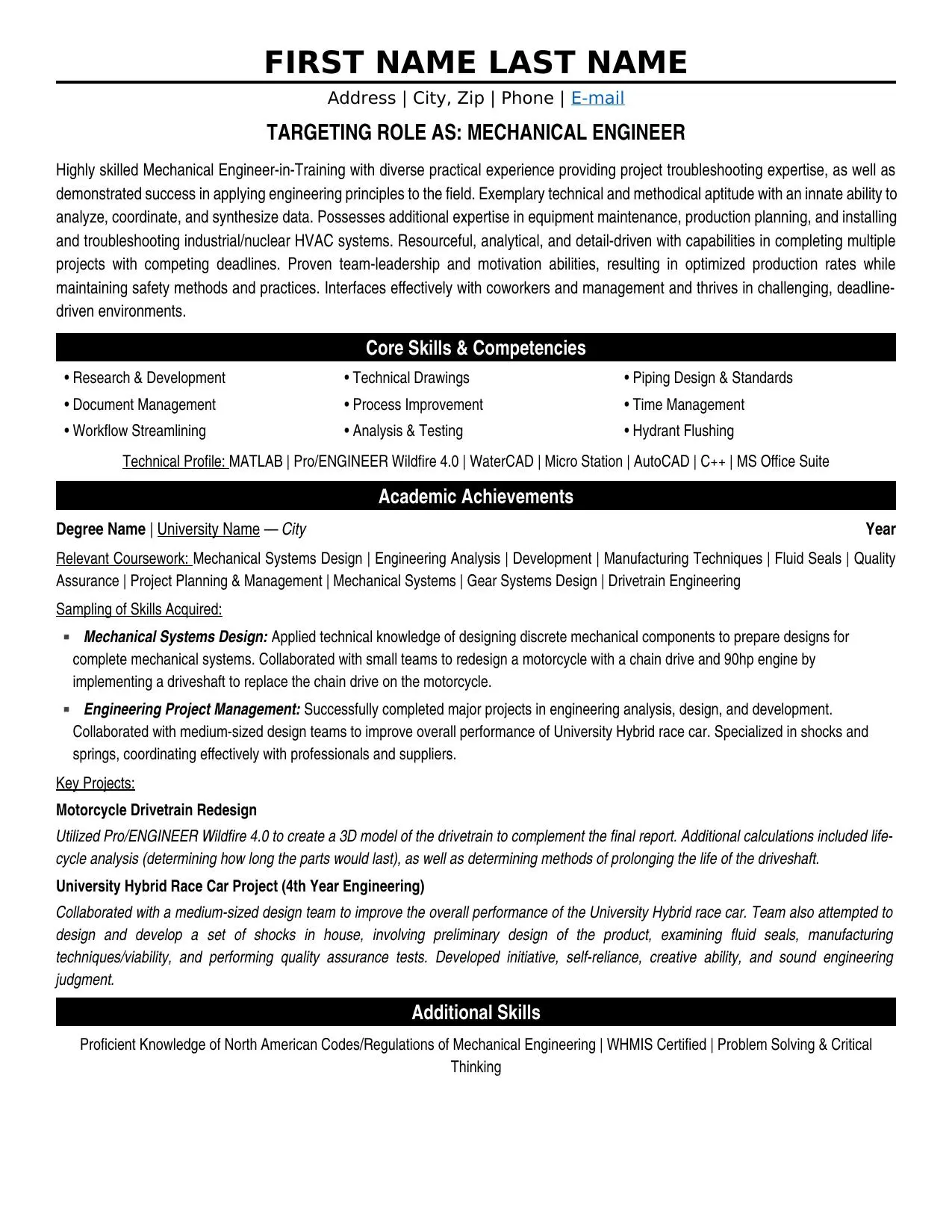
Utilized Pro/ENGINEER Wildfire 4.0 to create a 3D model of the drivetrain to complement the final report. Additional calculations included life-cycle analysis (determining how long the parts would last), as well as determining methods of prolonging the life of the driveshaft."
This transforms a class project into demonstrated professional capability. Specific details (90hp engine, driveshaft implementation) show real engineering decisions. Pro/ENGINEER proficiency and life-cycle analysis demonstrate industry-relevant skills. The project shows complete system design, not just component work.
Specialized in the shocks and springs, coordinating effectively with professionals and suppliers in the field to obtain a custom-sized/rebuilt and valved set of shocks."
This shows industry interaction (coordinating with professionals and suppliers), not just academic work. The custom specification process demonstrates real engineering procurement skills. Attempting in-house design shows initiative beyond minimum requirements. Hybrid race car work signals understanding of performance-critical applications.
Proven team-leadership and motivation abilities, resulting in optimized production rates while maintaining safety methods and practices. Proficient Knowledge of North American Codes/Regulations of Mechanical Engineering."
This differentiates the candidate from pure academics with hands-on industrial experience. Nuclear HVAC signals understanding of safety-critical environments. Code proficiency and WHMIS certification show regulatory awareness. Team leadership in production settings demonstrates workplace readiness beyond classroom projects.
How Do Engineering Resume Writers Transform a Mechanical Engineer In Training Resume?
Professional resume writers transform mechanical engineer in training resumes by analyzing job postings for required keywords, extracting specific achievements through targeted questions, quantifying impact with dollar values and percentages, and positioning you as the solution to employer problems.
We Analyze Mechanical Engineer In Training Job Postings
We identify exactly what hiring managers search for:
- Budget management and cost control requirements
- Schedule recovery and timeline management skills
- Site safety compliance and OSHA standards
- Subcontractor coordination and vendor management
We Extract Your Achievements
Our 1-on-1 interview uncovers:
- Project values and budgets you've managed
- Team sizes and subcontractors you've coordinated
- Problems you've solved that others couldn't
- Metrics you didn't think to track or quantify
We Quantify Your Impact
We find the numbers that prove ROI:
- Dollar values of projects completed on time
- Percentage of schedule improvements achieved
- Cost savings from value engineering decisions
- Safety record improvements and incident reductions
We Position You as the Solution
Your resume proves you solve employer problems:
- Delivering projects on time despite site challenges
- Managing subcontractors and maintaining quality
- Controlling costs while meeting specifications
- Leading teams through complex project phases
Listen to a Real Resume Interview
Hear how our writers extract engineering achievements through targeted questions.
What Does a Mechanical Engineer In Training Resume Interview Look Like?
A mechanical engineer in training resume interview is a conversation where our writer asks targeted questions about your projects, probes for specific details, and extracts achievements you'd never think to include.
Collaborated with a small team to redesign a motorcycle with a chain drive and 90hp engine by implementing a driveshaft to replace the chain drive on the motorcycle.
Utilized Pro/ENGINEER Wildfire 4.0 to create a 3D model of the drivetrain to complement the final report. Additional calculations included life-cycle analysis (determining how long the parts would last), as well as determining methods of prolonging the life of the driveshaft.
Every bullet on this resume was created through this same process.
Schedule Your InterviewHave questions? 1-877-777-6805
Watch How We Transformed Khoi's Resume
See how our interview process uncovered achievements that generic templates miss.
Get Your Resume Transformed
What a Mechanical Engineer In Training Resume Example That Gets Interviews Looks Like
A complete mechanical engineer in training resume is typically 1-2 pages and includes a professional summary, core competencies, detailed work experience with quantified achievements, education, and certifications. Here's an actual resume created through our interview process.
Which Mechanical Engineer In Training Resume Example
Do You Need?
The mechanical engineer in training resume you need depends on your career stage:
Breaking In
Your resume needs to prove engineering capability through academic projects, co-op experience, and technical skills.
Questions We Ask in Your Interview:
- What hands-on design projects have you completed?
- What CAD and analysis software are you proficient with?
What We Highlight on Your Resume:
- Capstone and senior design projects with real deliverables
- CAD software proficiency (Pro/E, SolidWorks, AutoCAD)
- Any co-op, internship, or practical work experience
Career Advancement
Your resume needs to demonstrate growing independence, project ownership, and progress toward licensure.
Questions We Ask in Your Interview:
- What projects have you owned or led significant portions of?
- What progress have you made toward P.Eng / PE licensure?
What We Highlight on Your Resume:
- Project ownership and independent problem-solving
- Technical specialization development
- P.Eng pathway progress (experience hours, exam status)
How Do You Write a Mechanical Engineer In Training Resume That Gets Interviews?
To write a mechanical engineer in training resume that gets interviews, focus on four key sections:
- Professional Summary — highlighting your experience level and specialty areas
- Skills Section — matching keywords from your target job postings
- Work Experience — quantified achievements using the Problem-Solution-Result format
- Credentials — relevant certifications and education
Most "how to write a resume" guides give you generic templates. We interview you to extract specific achievements. Here's what we focus on for Mechanical Engineers In Training:
What Should a Mechanical Engineer In Training Put in Their Professional Summary?
Your summary must signal job-readiness beyond classroom learning. Generic phrases like "eager engineering graduate" waste space—specific project types, software proficiencies, and practical experience immediately differentiate you.
Include your EIT designation, degree, practical experience areas (HVAC, automotive, manufacturing), key projects (hybrid race car, drivetrain design), and technical strengths (CAD proficiency, analysis capability, safety compliance).
For students and new graduates:
Expert Questions We Ask:
- "What hands-on design projects have you completed?"
- "What practical or co-op experience do you have?"
For EITs seeking full engineer roles:
Expert Questions We Ask:
- "What independent engineering work have you performed?"
- "What progress have you made toward P.Eng/PE?"
What Skills Should a Mechanical Engineer In Training Highlight?
Your skills must show both breadth and industry relevance. List specific software versions when notable. Include safety certifications and code knowledge—they signal workplace readiness that pure academics don't demonstrate.
Organize by category: Engineering Skills (R&D, analysis & testing, piping design), Process Skills (workflow streamlining, time management), then Technical Proficiencies with specific software (MATLAB, Pro/ENGINEER, AutoCAD, C++). Include regulatory knowledge (North American codes) and certifications (WHMIS).
Technical skills establish baseline capability:
Expert Questions We Ask:
- "What CAD and analysis software have you used?"
- "What industry codes or standards are you familiar with?"
Specialized skills support advancement:
Expert Questions We Ask:
- "What technical area are you developing expertise in?"
- "What certifications have you earned?"
How Should a Mechanical Engineer In Training Describe Their Projects?
EIT experience sections must show applied engineering, not just coursework completion. Industry interaction (coordinating with suppliers), real deliverables (3D models, reports), and technical analysis (life-cycle, QA testing) demonstrate professional capability.
Present academic projects with professional framing: objective (redesign drivetrain), your role (3D modeling, supplier coordination), tools used (Pro/ENGINEER), analysis performed (life-cycle analysis), and outcome (custom-specified components). Include any industry interaction.
Show engineering capability through projects:
Expert Questions We Ask:
- "What specific deliverables did you create?"
- "Did you interact with industry professionals or suppliers?"
Demonstrate growing independence:
Expert Questions We Ask:
- "What portions of projects have you owned?"
- "What problems have you solved independently?"
What Education Details Matter for EIT Resumes?
For EITs, education is your primary credential. EIT designation should be prominent. Relevant coursework with project descriptions can substitute for limited work experience. Academic achievements validate capability.
List your degree with university and graduation year. Include EIT/FE exam status prominently. Highlight relevant coursework that demonstrates specialization (Mechanical Systems Design, Thermodynamics). Include GPA if strong (3.5+). List academic honors or design competition participation.
Education establishes qualification:
Expert Questions We Ask:
- "What was your degree focus or specialization?"
- "Have you passed the FE exam / earned EIT designation?"
Continuing development supports advancement:
Expert Questions We Ask:
- "What additional training or certifications have you pursued?"
- "What is your timeline for PE exam?"
Skip the guesswork — let our expert resume writers ask these questions for you.
Schedule Your Resume InterviewHow Does a Resume Interview Extract
Your Mechanical Engineer In Training Achievements?
A professional resume interview extracts mechanical engineer in training achievements by probing into specific projects, uncovering the goals you were trying to achieve, documenting the systems and processes you implemented, and surfacing challenges you overcame.
What Projects Should You Include
on a Mechanical Engineer In Training Resume?
Include projects that demonstrate scope, stakes, and significance. We probe to understand the project value, team size, and your specific role.
How Do You Show Business Impact
on a Resume?
Connect your work to business outcomes by documenting the company's objectives and how your contributions achieved them.
What Systems and Processes
Should You Highlight?
Document the specific systems, processes, and strategies you implemented. This is where your expertise becomes visible.
How Do You Present
Challenges Overcome?
Describe challenges you faced and how you solved them. Problem-solving examples prove you can handle obstacles.
The Power of a 1-on-1 Resume Interview
No cookie-cutter calls. Your interview length matches your career complexity. We ask the questions you can't ask yourself.
Telephone Interview
- Students / New Grads
- Specialists, Analysts, Coordinators
- Targeting mid-level positions
Telephone Interview
- Individual Contributors
- Managers
- Career Changers
- Seeking Promotions
- Masters / Ph.D Holders
Telephone Interview
- Senior Managers
- Directors
- Department Heads
- Senior Writer Assigned
Telephone Interview
- Vice Presidents
- C-Suite Executives
- Business Owners
- Senior Writer Assigned
- Executive Resume Format
How Competitive Is the
Mechanical Engineer In Training Job Market?
Mechanical Engineer In Training jobs are medly competitive, averaging 64 applicants per position. With most job seekers applying to 20+ roles, you're competing against approximately 1,280 candidates for the same jobs.
Mechanical Engineer In Training Job
Jobs Posted (30 Days)
Per 20 Applications
Hardest to Land
Most competitive engineering rolesEasier to Land
Less competitive engineering rolesData based on LinkedIn job postings, updated February 2026. View full job market data →
Here's the math most job seekers don't do:
Your resume needs to stand out against 1,280 other engineering professionals.
Most of them list the same projects. The same certifications. The same responsibilities.
What makes you different is the story behind the projects.
Engineering Professionals We've Helped Are Now Working At
From general contractors to specialty trades, our clients land roles at top engineering firms across North America.
Reach Engineering's Hidden Job Market
80% of engineering positions are never advertised. Get your resume directly into the hands of recruiters filling confidential searches.
Engineering Recruiter Network
When you purchase our Resume Distribution service, your resume goes to 440+ recruiters specializing in engineering — included in Advanced & Ultimate packages.
Engineering Graduate Network
Detroit, MI
Mechanical Talent Partners
Toronto, ON
Sample Engineering Recruiters
440+ Total| Agency | Location |
|---|---|
EGN Engineering Graduate Network |
Detroit, MI |
MTP Mechanical Talent Partners |
Toronto, ON |
NER New Engineer Recruiters |
Houston, TX |
Frequently Asked Questions About
Mechanical Engineer In Training Resumes
A strong EIT resume should highlight capstone and design projects with specific deliverables, CAD software proficiency (Pro/ENGINEER, SolidWorks, AutoCAD), analysis tools (MATLAB, FEA software), and any practical experience (co-ops, internships, field work). Include technical calculations performed and industry interactions. EIT designation or FE exam status should be prominently displayed.
Entry-level mechanical engineering sees high competition, with many qualified graduates competing for positions. Candidates with co-op experience, hands-on projects (Formula SAE, design competitions), and industry software proficiency have significant advantages. Geographic flexibility and willingness to work in less popular locations can improve opportunities.
Present academic projects like professional work: state the objective (redesign motorcycle drivetrain), your contribution (created 3D model, performed life-cycle analysis), tools used (Pro/ENGINEER Wildfire 4.0), and outcome (complete system design). Include team size and any industry interaction. "Collaborated with suppliers to obtain custom-sized shocks" is stronger than "worked on race car project."
Industry-standard software includes SolidWorks (most common for entry-level), Pro/ENGINEER/Creo (manufacturing), CATIA (aerospace, automotive), and AutoCAD (2D drafting). Analysis tools like MATLAB and ANSYS add value. Knowledge of multiple platforms increases marketability. Certifications (CSWA, CSWP) can validate proficiency.
Include it if it demonstrates transferable skills: team leadership, production optimization, safety compliance, technical troubleshooting. Industrial HVAC work shows hands-on capability that pure academics lack. Frame it in engineering terms: "optimized production rates while maintaining safety standards" signals workplace readiness. Omit unrelated retail or food service unless you have no other experience.
The P.Eng / PE pathway requires: (1) accredited engineering degree, (2) FE/EIT exam passage, (3) supervised engineering experience (typically 4 years under licensed engineers), and (4) PE exam passage. Track your experience hours carefully. Seek work under P.Eng/PE supervision. Your resume should show progression toward licensure: "EIT designation, pursuing P.Eng with 2 years supervised experience."
Ready to Transform Your Resume?
Schedule your 15-minute interview and get a resume that proves you're the obvious choice.
Choose Your Interview LengthHave Questions?
Talk to an advisor who can recommend the right package for your situation.
Talk to an Advisor 1-877-777-6805