Infantryman
Resume Sample
A real resume example showing how we translate military experience into civilian-relevant proof employers trust
Being qualified isn't enough — you need to be the obvious choice.
We fix your resume with one conversation
What Makes a Strong Infantryman Resume?
An Infantryman resume must translate military experience into civilian-relevant skills including leadership, training, emergency response, and operations management. Employers scan for team coordination, security experience, and adaptability. This sample demonstrates how interview-extracted achievements showcase transferable military skills for civilian career transition.
Why Do Infantryman Resumes
Get Rejected?
Most infantryman resumes get rejected not because of ATS software, but because they don't prove you're better than the other 37 applicants. Generic bullets like "Coordinated with team and commanding officer on missions" don't differentiate you — quantified achievements do.
See how we transform generic statements into interview-winning proof:
Operated within team and alongside elite Special Forces soldiers according to chain of command to complete a range of tactical assignments and camp operational requirements. Maintained interoperability between numerous countries to communicate and complete tasks effectively."
This translates military coordination into civilian leadership terms: "team of 8+" demonstrates team leadership scale. "Order review and preparation" shows planning capability. Special Forces collaboration establishes elite operational level. Multi-country interoperability shows cross-functional communication.
External & Foreign Relations: Liaised with local Afghan police, army, and camp workers to develop understanding of local culture and customs. Communicated effectively to build interpersonal relationships with a wide range of NATO allies and societies, with deployments in the Middle East, Ukraine, and across North America."
This shows training and relationship skills: one-on-one training demonstrates instructional capability. Foreign soldier training shows cross-cultural competence. Afghan police liaison shows diplomatic skill. Three deployment regions (Middle East, Ukraine, North America) demonstrate adaptability and global experience.
Natural Disaster Relief: Responded to ecological disasters in populated and unpopulated areas, primarily flooding and wildfire relief efforts. Focused on preserving residences and structures alongside team and commanding officer.
Civilian & Victim Support: Assisted victims involved in accidents, including performing first aid and CPR techniques until professional medical responders arrived."
This shows inventory control and emergency response: weapons management demonstrates accountability and documentation skills. Serial number tracking shows attention to detail. Natural disaster response shows adaptability. First aid and CPR show emergency medical capability. These translate directly to security, logistics, and emergency services roles.
How Do Military Resume Writers Transform a Infantryman Resume?
Professional resume writers transform infantryman resumes by analyzing job postings for required keywords, extracting specific achievements through targeted questions, quantifying impact with dollar values and percentages, and positioning you as the solution to employer problems.
We Analyze Infantryman Job Postings
We identify exactly what hiring managers search for:
- Core technical skills and domain expertise required
- Leadership and team management expectations
- Industry certifications and compliance standards
- Tools, systems, and methodologies employers mention
We Extract Your Achievements
Our 1-on-1 interview uncovers:
- Specific results and outcomes you've delivered
- Team sizes and stakeholders you've managed
- Problems you've solved that others couldn't
- Metrics you didn't think to track or quantify
We Quantify Your Impact
We find the numbers that prove ROI:
- Revenue generated, costs saved, or budgets managed
- Percentage improvements in efficiency or quality
- Scale of operations, projects, or portfolios
- Time saved or deadlines consistently met
We Position You as the Solution
Your resume proves you solve employer problems:
- Delivering results under pressure and tight deadlines
- Leading teams and managing cross-functional stakeholders
- Driving improvements in processes and outcomes
- Bringing specialized expertise competitors lack
Listen to a Real Resume Interview
Hear how our writers extract military achievements through targeted questions.
What Does a Infantryman Resume Interview Look Like?
A infantryman resume interview is a conversation where our writer asks targeted questions about your projects, probes for specific details, and extracts achievements you'd never think to include.
Task Review & Execution: Coordinated with team of 8+ and commanding officer during order review and preparation to ensure all personnel understand responsibilities and intent of mission. Rehearsed mission prior to mission start for complete comprehension of requirements, allowing for efficient execution.
Operated within team and alongside elite Special Forces soldiers according to chain of command to complete a range of tactical assignments and camp operational requirements. Maintained interoperability between numerous countries to communicate and complete tasks effectively.
Every bullet on this resume was created through this same process.
Schedule Your InterviewHave questions? 1-877-777-6805
Watch How We Transformed Khoi's Resume
See how our interview process uncovered achievements that generic templates miss.
Get Your Resume Transformed
What a Infantryman Resume Example That Gets Interviews Looks Like
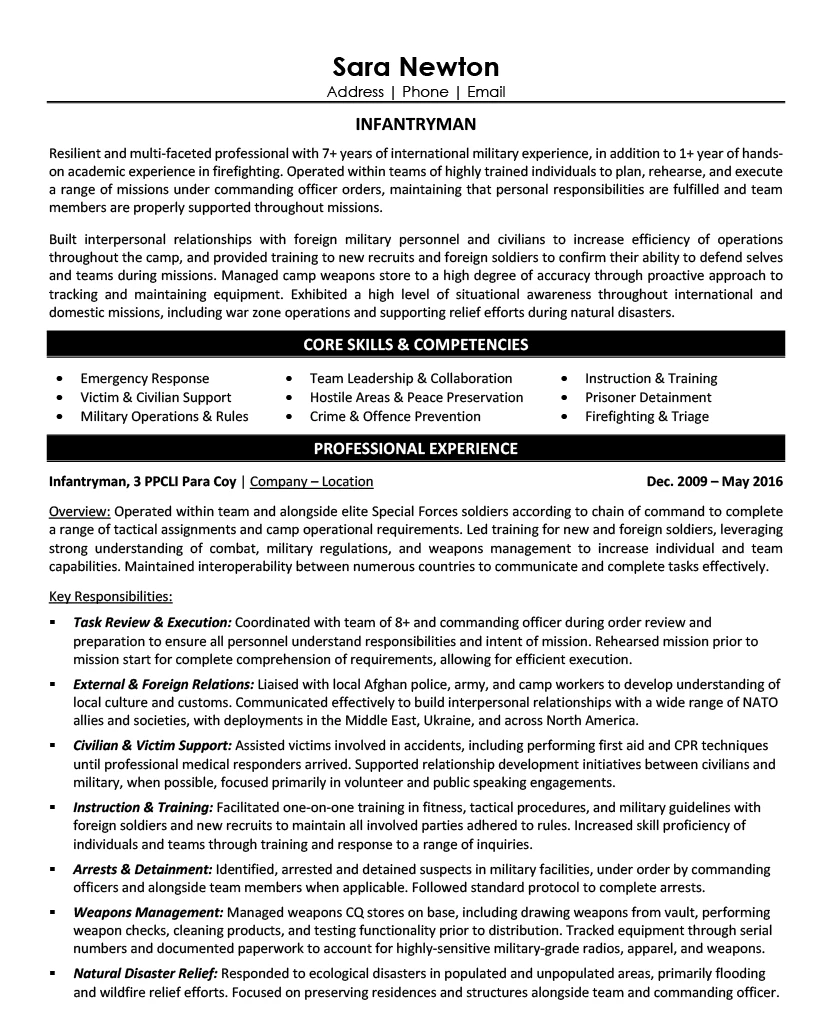
A complete infantryman resume is typically 1-2 pages and includes a professional summary, core competencies, detailed work experience with quantified achievements, education, and certifications. Here's an actual resume created through our interview process.
Which Infantryman Resume Example
Do You Need?
The infantryman resume you need depends on your career stage:
Military to Civilian Transition
Your resume needs to translate military skills into civilian-relevant terms and demonstrate adaptability.
Questions We Ask in Your Interview:
- What team sizes have you coordinated?
- What training have you delivered?
What We Highlight on Your Resume:
- Team of 8+ coordination
- Foreign soldier and recruit training
- First aid and CPR emergency response
Career Advancement
Your resume needs to demonstrate leadership, international operations, and specialized skills.
Questions We Ask in Your Interview:
- What international deployments have you completed?
- What specialized operations have you supported?
What We Highlight on Your Resume:
- NATO ally collaboration across Middle East, Ukraine, North America
- Special Forces soldier coordination
- Weapons management and inventory control
How Do You Write a Infantryman Resume That Gets Interviews?
To write a infantryman resume that gets interviews, focus on four key sections:
- Professional Summary — highlighting your experience level and specialty areas
- Skills Section — matching keywords from your target job postings
- Work Experience — quantified achievements using the Problem-Solution-Result format
- Credentials — relevant certifications and education
Most "how to write a resume" guides give you generic templates. We interview you to extract specific achievements. Here's what we focus on for Infantrymen transitioning to civilian careers:
What Should an Infantryman Put in Their Summary?
Your summary must translate military experience into civilian-relevant terms. "International military experience" establishes global scope. "Highly trained individuals" conveys elite team context. Equipment management shows accountability. Natural disaster relief shows community service orientation.
Include professional identity (resilient and multi-faceted professional), experience scope (7+ years of international military experience), team context (operated within teams of highly trained individuals to plan, rehearse, and execute a range of missions), relationship building (built interpersonal relationships with foreign military personnel and civilians), equipment responsibility (managed camp weapons store to a high degree of accuracy), and situational awareness (war zone operations and supporting relief efforts during natural disasters).
For civilian transition:
Expert Questions We Ask:
- "What team sizes have you led?"
- "What training have you delivered?"
For security or operations roles:
Expert Questions We Ask:
- "What international deployments have you completed?"
- "What specialized operations have you supported?"
What Skills Should Infantrymen Highlight?
Your skills must balance emergency response, leadership, and security. Emergency Response and Firefighting & Triage translate to emergency services. Team Leadership & Collaboration shows management capability. Instruction & Training enables training roles. Security skills translate to law enforcement and security management.
Lead with emergency skills (Emergency Response, Firefighting & Triage), then leadership skills (Team Leadership & Collaboration, Instruction & Training), then security skills (Hostile Areas & Peace Preservation, Crime & Offence Prevention, Prisoner Detainment), and include support skills (Victim & Civilian Support, Military Operations & Rules).
For civilian transition:
Expert Questions We Ask:
- "What emergency response have you done?"
- "What training have you delivered?"
For security advancement:
Expert Questions We Ask:
- "What hostile area operations have you completed?"
- "What crime prevention have you done?"
How Should Infantrymen Structure Experience?
Infantryman experience must be organized by transferable skill category. Overview establishes operational context. Key Responsibilities organized by function enables hiring managers to quickly identify relevant skills. Each section should translate to potential civilian applications.
Include Overview with context (elite Special Forces soldiers, tactical assignments, camp operational requirements). Organize Key Responsibilities by function (Task Review & Execution, External & Foreign Relations, Civilian & Victim Support, Instruction & Training, Arrests & Detainment, Weapons Management, Natural Disaster Relief). Translate military terms into civilian equivalents throughout.
Show transferable skills:
Expert Questions We Ask:
- "What team coordination have you done?"
- "What equipment have you managed?"
Demonstrate specialized capability:
Expert Questions We Ask:
- "What international operations have you supported?"
- "What training programs have you delivered?"
What Certifications Matter for Infantrymen?
For Infantrymen, certifications validate transferable skills. First Aid and CPR are universally valued. Firefighting training translates to emergency services. Military training credentials may have civilian equivalents. Security certifications strengthen candidacy for security roles.
Include emergency certifications (First Aid, CPR). Note specialized training (Firefighting, 1+ year academic experience). List military training that translates to civilian credentials. Security certifications (if obtained) add value for security roles.
Emergency certifications establish foundation:
Expert Questions We Ask:
- "What first aid certifications do you have?"
- "What specialized training have you completed?"
Professional certifications support advancement:
Expert Questions We Ask:
- "What security certifications do you hold?"
- "What law enforcement training have you completed?"
Skip the guesswork — let our expert resume writers ask these questions for you.
Schedule Your Resume InterviewHow Does a Resume Interview Extract
Your Infantryman Achievements?
A professional resume interview extracts infantryman achievements by probing into specific projects, uncovering the goals you were trying to achieve, documenting the systems and processes you implemented, and surfacing challenges you overcame.
What Projects Should You Include
on a Infantryman Resume?
Include projects that demonstrate scope, stakes, and significance. We probe to understand the project value, team size, and your specific role.
How Do You Show Business Impact
on a Resume?
Connect your work to business outcomes by documenting the company's objectives and how your contributions achieved them.
What Systems and Processes
Should You Highlight?
Document the specific systems, processes, and strategies you implemented. This is where your expertise becomes visible.
How Do You Present
Challenges Overcome?
Describe challenges you faced and how you solved them. Problem-solving examples prove you can handle obstacles.
The Power of a 1-on-1 Resume Interview
No cookie-cutter calls. Your interview length matches your career complexity. We ask the questions you can't ask yourself.
Telephone Interview
- Students / New Grads
- Specialists, Analysts, Coordinators
- Targeting mid-level positions
Telephone Interview
- Individual Contributors
- Managers
- Career Changers
- Seeking Promotions
- Masters / Ph.D Holders
Telephone Interview
- Senior Managers
- Directors
- Department Heads
- Senior Writer Assigned
Telephone Interview
- Vice Presidents
- C-Suite Executives
- Business Owners
- Senior Writer Assigned
- Executive Resume Format
How Competitive Is the
Infantryman Job Market?
Infantryman jobs are lowly competitive, averaging 38 applicants per position. With most job seekers applying to 20+ roles, you're competing against approximately 760 candidates for the same jobs.
Infantryman Job
Jobs Posted (30 Days)
Per 20 Applications
Hardest to Land
Most competitive military rolesEasier to Land
Less competitive military rolesData based on LinkedIn job postings, updated March 2026. View full job market data →
Here's the math most job seekers don't do:
Your resume needs to stand out against 760 other military professionals.
Most of them list the same projects. The same certifications. The same responsibilities.
What makes you different is the story behind the projects.
Military Professionals We've Helped Are Now Working At
Our clients land roles at leading military organizations across North America.
Reach Military's Hidden Job Market
80% of military positions are never advertised. Get your resume directly into the hands of recruiters filling confidential searches.
Military Recruiter Network
When you purchase our Resume Distribution service, your resume goes to 160+ recruiters specializing in military — included in Advanced & Ultimate packages.
Veteran Placement Services
Washington, DC
Military Transition Partners
San Diego, CA
Sample Military Recruiters
160+ Total| Agency | Location |
|---|---|
VPS Veteran Placement Services |
Washington, DC |
MTP Military Transition Partners |
San Diego, CA |
SES Security Executive Search |
Dallas, TX |
Frequently Asked Questions About
Infantryman Resumes
An Infantryman resume for civilian transition should highlight transferable skills (team leadership, training, emergency response), team coordination (8+ person teams, mission planning), international experience (NATO deployments, foreign relations), inventory management (weapons stores, serial number tracking), and emergency response (first aid, CPR, disaster relief). Translate military terminology into civilian-relevant language.
Replace military jargon with civilian equivalents: "order review" becomes "planning and coordination," "interoperability" becomes "cross-functional communication." Focus on universal skills: team leadership, training delivery, equipment management, emergency response. Quantify team sizes and scope: "team of 8+," "deployments in the Middle East, Ukraine, and across North America."
Infantrymen transition well to security management (physical security, asset protection), law enforcement (police, federal agencies), emergency services (fire, EMS, disaster response), operations management (logistics, warehouse management), and training roles (corporate training, fitness instruction). Defense contractors and government agencies actively recruit veterans.
Absolutely—international experience differentiates. "Deployments in the Middle East, Ukraine, and across North America" shows global adaptability. "NATO allies" demonstrates coalition experience. "Local Afghan police, army, and camp workers" shows cross-cultural capability. International deployments translate to global business, diplomatic, and security roles.
Document training delivery: "one-on-one training in fitness, tactical procedures, and military guidelines." Show audience diversity: "foreign soldiers and new recruits." Include outcomes: "increased skill proficiency of individuals and teams." Training experience translates to corporate training, instruction, and supervisory roles.
Balance emergency skills (Emergency Response, Firefighting & Triage, Victim & Civilian Support) with leadership skills (Team Leadership & Collaboration, Instruction & Training) and operations skills (Military Operations & Rules, Hostile Areas & Peace Preservation, Crime & Offence Prevention, Prisoner Detainment). Focus on skills that translate to target civilian role.
Ready to Transform Your Resume?
Schedule your 45-minute interview and get a resume that proves you're the obvious choice.
Choose Your Interview LengthHave Questions?
Talk to an advisor who can recommend the right package for your situation.
Talk to an Advisor 1-877-777-6805