Construction Worker
Resume Sample
A real resume example showing how we transform hands-on trade experience into proof employers trust
Being qualified isn't enough — you need to be the obvious choice.
We fix your resume with one conversation
What Makes a Strong Construction Worker Resume?
A Construction Worker resume must prove you can execute skilled trade work safely and efficiently while contributing to project success. Hiring managers scan for trade certifications, equipment proficiencies, safety training, and progression potential. This sample demonstrates how a 20-year veteran with Red Seal Journeyman Carpenter certification showcases their path from tradesperson to leadership.
Why Do Construction Worker Resumes
Get Rejected?
Most construction worker resumes get rejected not because of ATS software, but because they don't prove you're better than the other 37.5 applicants. Generic bullets like "managed construction projects" don't differentiate you — quantified achievements do.
See how we transform generic statements into interview-winning proof:
Utilize in-depth technical knowledge of heavy-duty equipment within team, tower cranes, 600 T crawler, and RT Mobiles, to maximize workflow efficiency. Collaborate with site supervisors to complete various lifts for sub trades."
Naming the specific project (Site C Dam) immediately signals industrial-scale experience. Equipment specifics like "600 T crawler" and "EFCO formwork" are keywords that match job postings for skilled construction workers. The collaboration aspect shows teamwork beyond just task execution.
The $40M+ figure immediately establishes scope and credibility. Listing specific project types (secant piles, dewatering, structural prep) demonstrates technical breadth. "Simultaneously coordinating" shows the ability to manage complexity—a key differentiator for advancement.
Maintained versatility in the workplace by combining knowledge from background within different trades to solve problems and develop workable solutions to accomplish various interconnected project tasks."
Historic building work signals premium skill level—these projects require adaptability and problem-solving beyond standard construction. The emphasis on cross-trade versatility differentiates this candidate from specialists who can only do one thing.
How Do Construction Resume Writers Transform a Construction Worker Resume?
Professional resume writers transform construction worker resumes by analyzing job postings for required keywords, extracting specific achievements through targeted questions, quantifying impact with dollar values and percentages, and positioning you as the solution to employer problems.
We Analyze Construction Worker Job Postings
We identify exactly what hiring managers search for:
- Budget management and cost control requirements
- Schedule recovery and timeline management skills
- Site safety compliance and OSHA standards
- Subcontractor coordination and vendor management
We Extract Your Achievements
Our 1-on-1 interview uncovers:
- Project values and budgets you've managed
- Team sizes and subcontractors you've coordinated
- Problems you've solved that others couldn't
- Metrics you didn't think to track or quantify
We Quantify Your Impact
We find the numbers that prove ROI:
- Dollar values of projects completed on time
- Percentage of schedule improvements achieved
- Cost savings from value engineering decisions
- Safety record improvements and incident reductions
We Position You as the Solution
Your resume proves you solve employer problems:
- Delivering projects on time despite site challenges
- Managing subcontractors and maintaining quality
- Controlling costs while meeting specifications
- Leading teams through complex project phases
Listen to a Real Resume Interview
Hear how our writers extract achievements that prove you can deliver.
What Does a Construction Worker Resume Interview Look Like?
A construction worker resume interview is a conversation where our writer asks targeted questions about your projects, probes for specific details, and extracts achievements you'd never think to include.
Work at the industrial Site C Dam project includes numerous opportunities as a journeyman carpenter working with various formwork systems, primarily EFCO and with a variety of cranes in an industrial environment.
Utilize in-depth technical knowledge of heavy-duty equipment within team, tower cranes, 600 T crawler, and RT Mobiles, to maximize workflow efficiency. Collaborate with site supervisors to complete various lifts for sub trades.
Every bullet on this resume was created through this same process.
Schedule Your InterviewHave questions? 1-877-777-6805
Watch How We Transformed Khoi's Resume
See how our interview process uncovered achievements that generic resume writing would miss.
Get Your Resume Transformed
What a Construction Worker Resume Example That Gets Interviews Looks Like
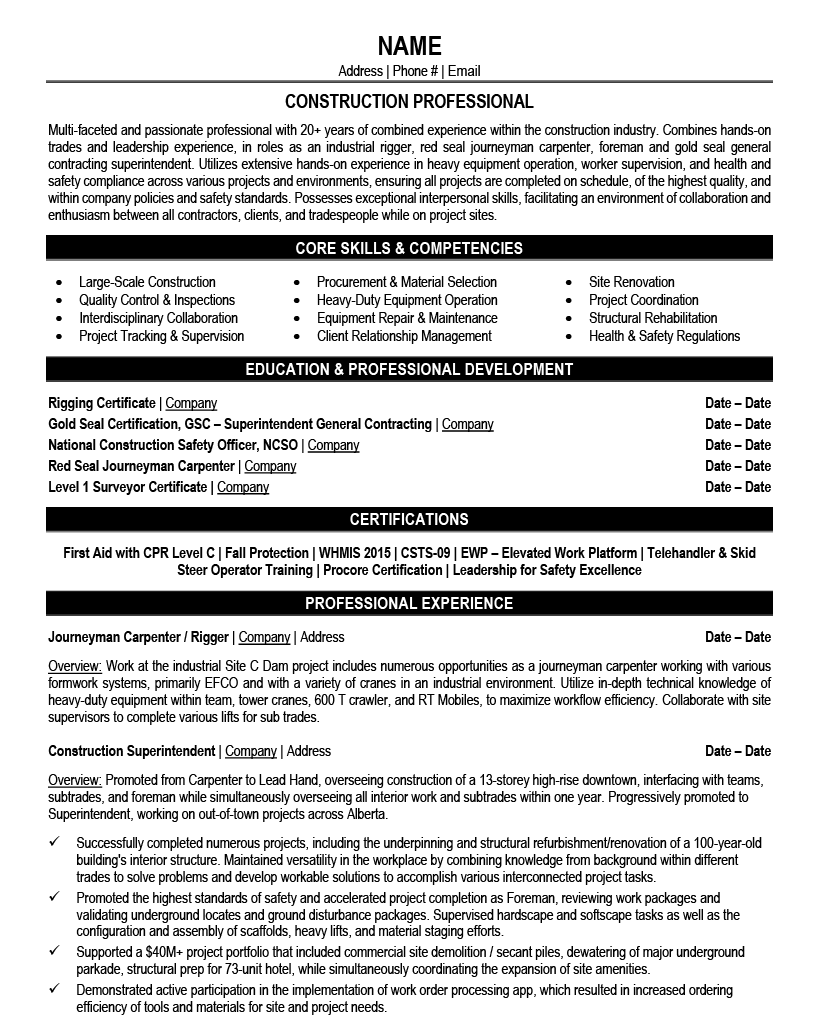
A complete construction worker resume is typically 1-2 pages and includes a professional summary, core competencies, detailed work experience with quantified achievements, education, and certifications. Here's an actual resume created through our interview process.
Which Construction Worker Resume Example
Do You Need?
The construction worker resume you need depends on your career stage:
Career Advancement
Your resume needs to prove you can handle physical demands, follow safety protocols, and work effectively with a crew.
Questions We Ask in Your Interview:
- What safety certifications have you completed?
- What equipment or tools are you proficient with?
What We Highlight on Your Resume:
- Safety training and certifications that show commitment
- Physical capabilities and reliability indicators
Senior Transition
Your resume needs to differentiate you through certifications, leadership moments, and project contributions.
Questions We Ask in Your Interview:
- What trade certifications have you earned or are pursuing?
- When have you taken on leadership or training responsibilities?
What We Highlight on Your Resume:
- Red Seal or trade-specific certifications
- Progression from helper to skilled tradesperson to leader
How Do You Write a Construction Worker Resume That Gets Interviews?
To write a construction worker resume that gets interviews, focus on four key sections:
- Professional Summary — highlighting your experience level and specialty areas
- Skills Section — matching keywords from your target job postings
- Work Experience — quantified achievements using the Problem-Solution-Result format
- Credentials — relevant certifications and education
Most construction resume guides give you generic templates. We interview you to extract specific achievements that prove your value—from the equipment you operate to the projects you've delivered.
What Should a Construction Worker Put in Their Professional Summary?
Your summary must signal whether you're entry-level or experienced, your specialization, and your safety consciousness.
Lead with years of experience, your primary trade, key certifications, and the scale of projects you've worked on.
For those entering construction or moving to skilled roles...
Expert Questions We Ask:
- "What safety training have you completed?"
- "What physical or hands-on work have you done that translates?"
For experienced tradespeople seeking advancement...
Expert Questions We Ask:
- "What certifications set you apart (Red Seal, Gold Seal)?"
- "What's the largest or most complex project you've contributed to?"
What Skills Should a Construction Worker Highlight?
Skills must be specific and verifiable—not just "construction experience" but "EFCO formwork systems" and "600 T crawler crane operation."
Lead with trade-specific skills, equipment proficiencies, and safety competencies that match your target role.
Entry-level should emphasize trainability and safety awareness...
Expert Questions We Ask:
- "What tools and equipment are you already comfortable with?"
- "What safety protocols have you been trained on?"
Experienced workers should show breadth and depth...
Expert Questions We Ask:
- "What specialized systems or methods do you know (formwork, rigging)?"
- "What leadership or coordination skills have you developed?"
How Should a Construction Worker Describe Their Experience?
Each role should show what you built, how you contributed, and evidence of increasing responsibility.
Name specific projects, quantify scope (project value, building size, crew size), and highlight progression.
New workers should focus on reliability and learning...
Expert Questions We Ask:
- "What tasks were you trusted to complete independently?"
- "How did you demonstrate reliability and work ethic?"
Experienced workers should emphasize impact and leadership...
Expert Questions We Ask:
- "What problems did you solve that others couldn't?"
- "When did you train, lead, or mentor others?"
What Education and Certifications Matter for Construction Workers?
List certifications with issuing bodies and dates. Include both trade credentials and safety training.
Trade certifications often matter more than formal education. Prioritize Red Seal, journeyman credentials, safety certs, and equipment licenses.
Entry-level certifications show commitment...
Expert Questions We Ask:
- "What safety certifications have you completed (OSHA 10/30, First Aid)?"
- "Are you enrolled in any apprenticeship programs?"
Advanced certifications differentiate experienced workers...
Expert Questions We Ask:
- "Do you have Red Seal, Gold Seal, or equivalent credentials?"
- "What specialized training sets you apart (rigging, crane operation)?"
Skip the guesswork — let our expert resume writers ask these questions for you.
Schedule Your Resume InterviewHow Does a Resume Interview Extract
Your Construction Worker Achievements?
A professional resume interview extracts construction worker achievements by probing into specific projects, uncovering the goals you were trying to achieve, documenting the systems and processes you implemented, and surfacing challenges you overcame.
What Projects Should You Include
on a Construction Worker Resume?
Include projects that demonstrate scope, stakes, and significance. We probe to understand the project value, team size, and your specific role.
How Do You Show Business Impact
on a Resume?
Connect your work to business outcomes by documenting the company's objectives and how your contributions achieved them.
What Systems and Processes
Should You Highlight?
Document the specific systems, processes, and strategies you implemented. This is where your expertise becomes visible.
How Do You Present
Challenges Overcome?
Describe challenges you faced and how you solved them. Problem-solving examples prove you can handle obstacles.
The Power of a 1-on-1 Resume Interview
No cookie-cutter calls. Your interview length matches your career complexity. We ask the questions you can't ask yourself.
Telephone Interview
- Students / New Grads
- Specialists, Analysts, Coordinators
- Targeting mid-level positions
Telephone Interview
- Individual Contributors
- Managers
- Career Changers
- Seeking Promotions
- Masters / Ph.D Holders
Telephone Interview
- Senior Managers
- Directors
- Department Heads
- Senior Writer Assigned
Telephone Interview
- Vice Presidents
- C-Suite Executives
- Business Owners
- Senior Writer Assigned
- Executive Resume Format
How Competitive Is the
Construction Worker Job Market?
Construction Worker jobs are lowly competitive, averaging 38.5 applicants per position. With most job seekers applying to 20+ roles, you're competing against approximately 770 candidates for the same jobs.
Construction Worker Job
Jobs Posted (30 Days)
Per 20 Applications
Hardest to Land
Most competitive construction rolesEasier to Land
Less competitive construction rolesData based on LinkedIn job postings, updated February 2026. View full job market data →
Here's the math most job seekers don't do:
Your resume needs to stand out against 770 other construction professionals.
Most of them list the same projects. The same certifications. The same responsibilities.
What makes you different is the story behind the projects.
Construction Professionals We've Helped Are Now Working At
From general contractors to specialty trades, our clients land roles at top construction firms across North America.
Reach Construction's Hidden Job Market
80% of construction positions are never advertised. Get your resume directly into the hands of recruiters filling confidential searches.
Construction Recruiter Network
When you purchase our Resume Distribution service, your resume goes to 450+ recruiters specializing in construction — included in Advanced & Ultimate packages.
Build Staffing
Denver, CO
TradeForce Recruiting
Houston, TX
Sample Construction Recruiters
450+ Total| Agency | Location |
|---|---|
BS Build Staffing |
Denver, CO |
TR TradeForce Recruiting |
Houston, TX |
CC Construction Careers |
Chicago, IL |
Frequently Asked Questions About
Construction Worker Resumes
A strong construction worker resume should include trade certifications (Red Seal, journeyman credentials), safety training (OSHA, fall protection, first aid), equipment proficiencies (specific tools, machinery, formwork systems), and project examples with scope indicators. This sample shows certifications like Red Seal Journeyman Carpenter and NCSO prominently, followed by specific project work on industrial sites.
Document your path from entry-level to skilled positions with clear title progression. This resume shows advancement from Carpenter to Lead Hand to Foreman to Superintendent—each role building on the last. Include the scope increase at each level: larger crews, bigger budgets, more complex projects.
The most valuable certifications depend on your trade and target role. This sample highlights Red Seal Journeyman Carpenter (trade mastery), Gold Seal Superintendent (management credential), NCSO (safety leadership), and equipment-specific certs like Rigging Certificate and Elevated Work Platform. Safety certifications like First Aid, Fall Protection, and WHMIS are baseline requirements.
Replace vague descriptions with specific project details. Instead of "worked on construction sites," this resume names the Site C Dam project, specifies EFCO formwork systems, and lists exact equipment (600 T crawler crane, RT Mobiles). Include project values ($40M+ portfolio), building specifics (13-storey high-rise, 73-unit hotel), and unique challenges (100-year-old building renovation).
Yes—equipment proficiency is a key differentiator. List specific equipment by name: tower cranes, crawler cranes with tonnage, telehandlers, skid steers. Include software like Procore if you use it. This resume lists Technical Acumen including formwork systems and crane types, making it easy for hiring managers to match skills to job requirements.
Construction worker roles typically see 38.5 applicants per job on average, though this varies by specialization and location. Skilled trades with certifications face less competition than general labor positions. Having Red Seal or journeyman credentials, safety certifications, and documented experience on named projects significantly improves your competitiveness.
Ready to Transform Your Resume?
Schedule your 90-minute interview and get a resume that proves you're the obvious choice.
Choose Your Interview LengthHave Questions?
Talk to an advisor who can recommend the right package for your situation.
Talk to an Advisor 1-877-777-6805